AI For Experienced Software Engineers

I started programming 23 years ago. It’s given my family a great life. I like to write code. I like to craft software. I like to architect systems. Now agents help me with all that.
The disillusionment from software engineers on the timeline is understandable. Things won’t ever be the same again, but I believe this is the best time ever to be in our profession.
couple of my best software engineering buddies are really struggling lately
— Stefan (@savram8) November 10, 2026
over their career they’ve really made their identity being the person who knows deeply about programming
because of LLMs they’re feeling a identify crisis and struggling to adapt
:/
Our days of writing code are over, but our days of building cool products at an unprecedented pace are just beginning. And that’s incredibly exciting.
In my 2025 end of year review, I wrote that Anthropic’s Opus 4.5 model was “excellent at generating good code under guidance”. With hindsight, this release was the moment things changed forever. AI became as good as an experienced software engineer at producing code.
Since then, models have got better and I’ve leant in. From using Claude Code on singular tasks to having tens of agents running in parallel through harnesses.
AI is at the start of everything I do. From organising my calendar, to building side projects and in my role as Staff Engineer at OpenSea.
I’ve already made over 6x as many GitHub contributions (almost all production code) in 2026 as I did in the whole of 2025.
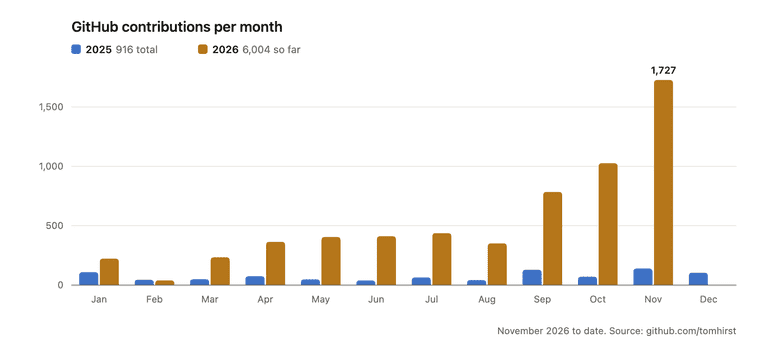
Furthermore, my pace is accelerating as the months pass. It’s incredible what you can achieve as a knowledgeable manager of agents; and that’s what we are now.
I’m most interested in how people are using AI in reality—beyond the hype. If you’re the same, this article is for you.
So how do you get from where you were to where you need to be as an experienced software engineer heading into 2027? Here’s what I’ve learned about agentic engineering so far.
Start At The Deep End
If you’ve been in software for a while, your journey with AI might look something like this:
- Copilot autocomplete in VS Code (Kinda cool)
- Cursor’s side panel prompting (I have a pairing partner available at all times)
- Claude Code, Opus 4.5+ (This model writes great code)
- OpenClaw (I can code from my phone)
- Cloud agent setups like Devin (How we write software has changed forever)
In the last 2-3 years, you had the advantage of becoming AI native gradually. Now you have no choice but to start at the deep end. This means thinking agent-first for everything:
- Planning: Co-write the spec and fixed constraints with an agent before any code.
- Designing: Prototype with agents and throw away early versions freely.
- Orchestrating: One subagent per task, with small PRs.
- Writing code: Agents write it. You set the context and the definition of done.
- Testing and QA: Agents write tests, run simulators and attach screenshots as proof.
- Reviewing code: Agents review first, humans can make the final decision on higher risk merges.
- Deploying and monitoring: Agents watch deploys and look into incidents.
- Everything else: Calendar, inbox, side projects. If you’re doing it by hand, ask yourself why.
Being an early adopter has always been important as a technologist. Now more than ever, it’s your job to get better at your job.
Everything Has Changed and Everything Is The Same
So there’s work to do. To be clear: you’ll rarely write code again. In many cases, you won’t even read it. Your output and productivity will multiply.
I understand the disappointment of those who identified as experts at writing code. I used to find crafting syntax cathartic, too. But being self-taught, I’ve always been more focused on what I can build than how I build it. Code was always a means to an end.

Here’s the good news: your experience is still incredibly relevant. Agents can write the code, but they can’t tell you what’s worth building. That still comes from years on product teams, watching systems succeed and fail. The trade-offs you make as an experienced engineer are still yours to own. The way you write code has changed, but the way you build systems stays the same.
This is where being self-taught helps you.
— Tom Hirst (@tom_hirst) November 11, 2026
Having your own projects or business before, too.
I also enjoyed the craft. But it was always a means to shipping cool stuff. https://t.co/yuwy3Eeudm
So what types of engineer are flourishing? The ones who can take an idea all the way to users. The cycle of build, ship and learn has got much tighter, and it’s often driven by one person, or at least far fewer people than before. If you’ve built and launched your own projects end to end, you already know how to work this way.
Specialist Roles Are Gone
You’re not a front or back end engineer anymore. You’ll be expected to work across (and beyond) the stack, and agents will help you do it. Expect to do more design and product work too.
The job market shows it. According to Lenny’s state of the tech job market for late 2026, demand for mobile and front end engineers has nearly halved in the past year, which he puts down to “the collapse of specialized/siloed engineering disciplines”.
Meanwhile, forward deployed engineer openings are up 4.6x. That’s an engineer who sits close to the customer and builds whatever closes the gap. Front end, back end, infra, data, docs. Whatever it takes. We’re seeing this in startups too, with the rise of the product engineer. It’s how I described my own role last year.
STATE OF THE TECH JOB MARKET IN 2026
— Lenny Rachitsky (@lennysan) November 10, 2026
Twice a year, I dig into trends in hiring and job openings. This is the fifth report I've done, and the most surprising yet:
1. PMs are winning in the AI era
2. Engineering demand has stalled
3. Design openings are at a record low
4. Every… pic.twitter.com/etQlxinDoF
I’ve always been full stack. With PHP in my WordPress days, then onto React and Node in TypeScript. Once you grok your first programming language the patterns stick; how data flows, state is managed and UI is composed.
A strong software engineering background helps with agents. They’re great at writing syntax you’ve never written before, but your exposure to architecture patterns is what helps you guide them.
Mobile is what I’ve done most this year, and I’d barely touched it before. I hadn’t written Kotlin before 2026 but I’ve made over 1,000 commits to OpenSea mobile, which launched in September.
So when everyone can ship across the stack, what can set you apart? Product ideas. Prototypes. Proactive decision making. Clear communication, especially written. Helping with GTM on socials. Using the product you’re building; you’ll spot what’s broken before any ticket comes in.
How To Work With Your Agent
Start with context. Building production features usually means working across multiple services. If they’re in different repos, consider a monorepo. Your agent needs to understand how your code fits together.
Plan anything bigger than a quick fix. Co-write the spec with your agent and break it down PR by PR. Tell it the outcome you want, what must be true when it’s done and what must not break along the way.
Prompts should read like a brief you’d give a teammate. Light on detail, but explicit where it counts. “Fix the jank on this page” gets you something. “Get mobile CLS on the collection page under 0.1” gets you something you can measure. Agents work best when they can check their own progress.
The same goes for persistence, which doesn’t always come for free. “Deep dive this until you find the root cause” gets a very different result to “look into this”.
Don’t be afraid to give your agent agency, as long as the guardrails are in place. Be clear about what it’s allowed to do. If you want a PR, say so. If it can merge when automated review gives a confident score, say that too.
One thing I’ve changed my mind on between the first and second half of 2026: you probably need fewer skills than you think. The one I use most takes a change from first commit to a merge-ready PR. Native tools like Claude Ship are starting to do this out of the box. Add too many skills and the overlap can work against you. Frontier models can often make the leaps a skill spells out on their own.
The line between trusting an agent and guiding it moves with every model release. What needed hand-holding six months ago might not now. You can go by feel, but evals are better. Take a fixed set of tasks you already know the answer to, like bugs you’ve fixed, and rerun them from before the fix when a new model lands or you change a skill. Track how many pass, what they cost and how long they take to reach a viable PR. The numbers will show you where you can strip back some scaffolding.
Pebbles, Rocks and Wheels
Agents feed your bias to action. A small bug that might once have sat in the backlog can have an agent on it the moment it’s reported. Tagging an agent in Slack to start an investigation is now my default. Having agents where you already work is a big unlock.
Turn-by-turn work with a single agent in the CLI is a solid entry point for software engineers. Claude Code will even fire up background agents for you. But the real productivity gains come from running longer sessions across multiple projects and tasks at once. Cloud agents make this possible (no more walking around with your laptop ajar), and overnight runs mean things keep moving while you sleep.
Most cloud agent harnesses share a similar UI: a long list of running sessions that ping you when they finish or need input. I find it hard to know where to look next. Every task blurs into the same level of importance, and you end up as the context switch. Jumping between ten threads to work out which one needs you first kills any chance of flow. Running work in parallel is a skill you have to train deliberately, and it’s worth experimenting with systems and UIs that help.
What’s helped me most is a mental model: thinking about work by its shape, because each shape needs a different kind of attention. I’m experimenting with it in my own setup. Work is sorted into three buckets and pings are ranked by importance. I call them pebbles, rocks and wheels.
- Pebbles: One-off tasks that need fixing fast, like that bug from Slack. One cohesive PR. They need a quick glance at the result.
- Rocks: Bigger features. Plan once, then delegate each PR to its own subagent to ship in tandem. They need real thought up front, then QA at feature milestones.
- Wheels: Recurring mandates, like keeping dependencies current or finding bugs in user flows. They run on a schedule, discover problems and fix them. They shouldn’t need me much at all.
Each bucket has its own rules on top of a shared set. A pebble doesn’t need a plan, but a rock can’t skip one. Some rules apply everywhere, like keeping PRs under 750 changed lines. Skills and context work the same way, scoped to one bucket or shared across all three.
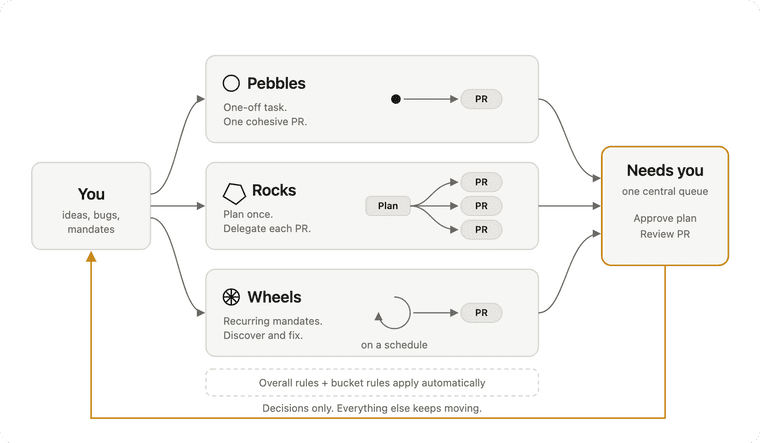
Anything that needs me lands in a single queue. Approve a plan. Review a PR that touches a hot path. Grant scoped access. I make the decisions, and the agents’ default is to keep moving.
I’m still experimenting with how I work with agents through custom harnesses like this. I think it matters because the bottleneck has moved. Agents can run all night, but my attention can’t. The tools that win will be the ones that spend it best.
Verification and The Long Tail
Spending your attention well means accepting you can’t review every line. We’re producing too much code for that. Writing code is no longer the hard part. Proving it works is. You don’t want rogue agents, but you don’t want to babysit them either. Finding the middle ground takes trust, and trust takes guardrails.
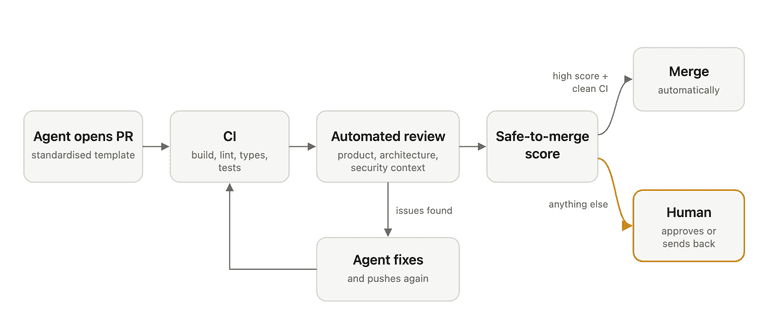
The obvious place to start is a pipeline every change goes through, whoever wrote it. Mine looks like this:
- The agent opens a PR using a standardised template.
- CI runs the build, lint, type checks and tests.
- Automated review checks the change with context on product, architecture and security.
- The agent fixes what review finds and pushes again.
- The PR gets a safe-to-merge score.
- A high score with clean CI merges. Anything else goes to a human.
One warning on tests. An agent working on its own tests will often bend them towards what it built, writing tests that confirm the code or weakening ones that don’t. When Anthropic migrated their Messages API to Rust, they found more than 100 weakened assertions in their ported tests. A pass isn’t proof on its own. Ask for proof you can see: simulator screenshots, before and after metrics, a recording of the flow.
Evidence is how you know the work is having an impact. If you can measure something on the main branch, then again with the PR on top, you can prove the impact of the code before it’s merged. Agents can do this for you with simulators. On a recent mobile performance push, one PR cut Android UI-thread frame time by 64%. Another moved some work off the iOS main thread, taking it from around 20ms each time it ran (longer than a whole frame) to 0.1ms. Hard numbers are hard to argue with, and you don’t need to read every line to trust them.
But not every agent-led task deserves the same level of trust. New features can often be automated end to end, because they’re behind a feature flag and nothing switches on until the rollout is checked. Changes to hot paths get a human sign-off. Database migrations I read to check the schema is right for the system as a whole, not just the feature. And when something breaks, agents dig through logs with me, but the call on what to do is mine.
The person prompting is a trust vector. An experienced engineer steers the agent before it writes a line, notices when it’s drifting and knows when to throw the code away and start again. Judgement is still important, it’s just higher up the stack.
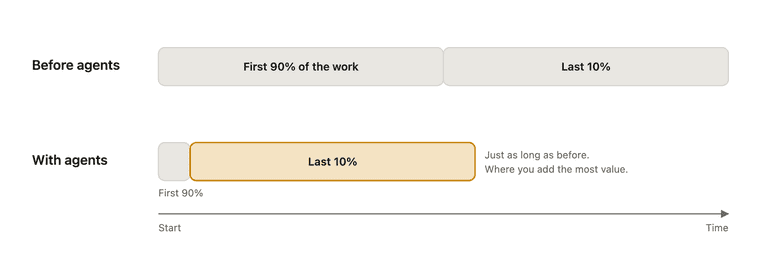
Once you have a pipeline you trust, you can merge with confidence, and in parallel. But if you’ve been in software long enough, you’ll know the long tail is always the hard part. Testing by hand on device, walking through complex flows, getting a sense of how a change affects the feel of the product. Agents might make the first 90% ten times faster, but the last 10% is where you add the most value.
Backlog To Built
Every team has a backlog of things that never get started. The internal tool that would save everyone an hour a week. The migration that keeps getting pushed to next quarter. The idea someone raised in a retro two years ago. They don’t stay there because they’re bad ideas. They stay there because starting is expensive. Agents change that. The biggest benefit isn’t just building faster, it’s starting sooner.
I’m not oblivious to the fact that this website needs a new lick of paint. In my other work, I’m leaning on agents to get from idea to action faster than ever.
When code is cheap, the question changes from “can we afford to build this?” to “should we?“.
You’ll notice it first with internal software. Tools that never made the roadmap now take a day. Some of what I’ve built is just for fun. Some of it matters more, like full metrics dashboards spun up in a single session.
Developer experience has always mattered, but teams can now shape their own instead of waiting for someone else to prioritise it. That includes how you work with agents. Building your own harness used to be a project in itself. Now you can prototype one in a day and keep changing it as your workflow does. That’s how I’m iterating on pebbles, rocks and wheels.
Building your own tools isn’t only about speed. It’s about control. Security incidents are becoming more common, and every third-party tool is another dependency you have to trust. When building it yourself is cheap, owning more of your stack becomes a realistic option.
You can be more ambitious than feels reasonable. Once a feature shipped on web, the question used to be whether mobile could follow next sprint. Now it’s whether mobile can ship in the same sprint. Cognition, the team behind Devin, say a single long-running agent built their Android app in 44 days, merging 1,134 PRs with just 183 messages from the engineer overseeing it.
Rewrites are fair game too. If you wanted to move a small web app from Next.js to TanStack Start, you could do it in an afternoon and have it deployed by the evening. Bigger ones are only as safe as your ability to verify them. That’s where your experience counts: knowing what’s worth rewriting, which invariants have to survive it and how you’ll prove they did.
With all that said, starting fast isn’t the same as adding value. It’s easy to fall into a dopamine loop of merged PRs and green checks that feel like product progress. Features still need to reach users, and numbers still need to move up and to the right.
The Trade-Offs
None of this is free. Running tens of agents in parallel burns through tokens fast. Individual subscriptions are great value, and they’ll take you a long way on side projects. But for work at the scale I’ve described, you’ll be paying per token through APIs. At a lab, a big tech company or a well-funded startup, that’s doable. For everyone else, it’ll get expensive fast.
But there’s hope on cost. Competition between labs, and from open-weight models, keeps pushing prices down. Google’s Gemini 4 Neon topped the Artificial Analysis Coding Agent Index at launch, priced at $3 per million input tokens and $15 per million output. That’s mid-tier pricing per token for frontier-level coding. My prediction is that within a year or two, that’ll be the norm rather than the exception. The catch is, of course, that we’ll keep using more. Cheaper tokens might just mean more agents.
This is where your evals earn their keep. If a cheaper model passes the same tasks, use it. Tools like OpenRouter make switching between models and providers easy.
There’s also the cost of context switching. Running parallel work streams is a muscle to be trained. It feels natural to me because of my freelance days, when I’d juggle two or three client projects at once. More than three large work streams is where I start to see diminishing returns. Pebbles, rocks and wheels is my attempt to push that limit a little further.
Agents help you work wherever you are. You can ship a fix from your phone between sets at the gym. But sometimes a walk without looking at your phone is the best walk you’ll ever take.
Working with agents as a team is still rough around the edges. When an agent opens a PR that needs human verification, it’s not always clear which human owns reviewing it. And a message from someone’s agent can feel less personal than one from the person themselves. I think that will change. As agents get better at talking to each other directly, we’ll care less about who typed what and more about whether the work is right and valuable.
Organisational memory is harder. Agents don’t know why past decisions were made unless you tell them. A shared context layer helps, but someone still has to keep it current. And the fully autonomous software factory, where agents find and fix bugs end to end, is close, but it still needs a human to decide what’s worth fixing.
In my opinion, agentic engineering rewards people who see code as a means to an end and have a bias to action. If that’s you, the trade-offs are worth it.
In Summary
You can’t opt out any longer, but the parts of your experience that mattered most still do. System design, product sense and knowing how things get built from idea to production are worth more now, not less.
The job has moved up the stack. Brief your agents well, verify what they produce and spend your attention where it counts. Then be more ambitious than ever before.
If you’ve freelanced, shipped side projects or worn many hats at a startup, you’ve been training for this without knowing it. The code itself was never the valuable part. Solving problems, quickly and end to end, was.
There’s so much software still to be written. Lean in. You and your agents can write it.